Lumit® FcRn Binding Immunoassay
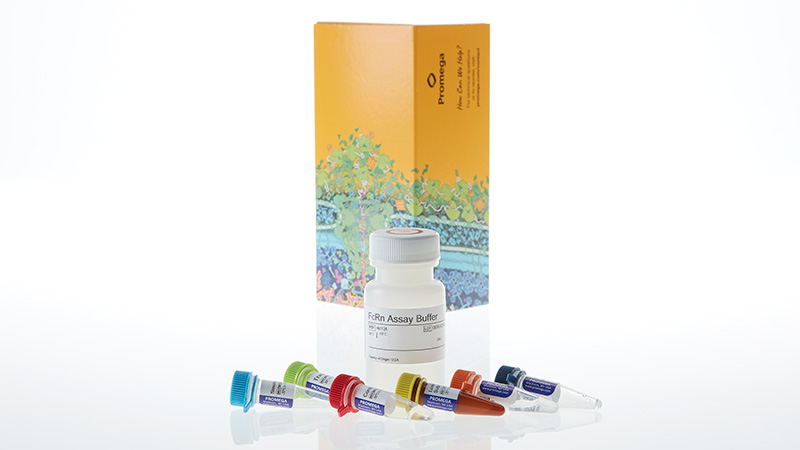
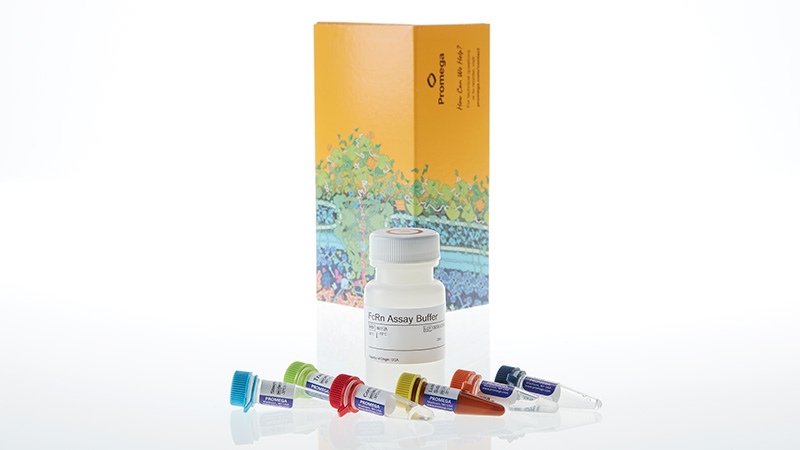
Measure Neonatal Fc Receptor Binding
- No wash or transfer: Simple add-mix-read protocol
- Results in less than one hour
- Scalable and high throughput: Perform assays in 96-well or 384-well plates

Catalog Number:
Size
Catalog Number: W1151
Catalog Number: W1152
A Faster, Simpler FcRn Assay
The Lumit® FcRn Binding Immunoassay is a novel homogeneous (no-wash) competition assay to measure the interaction between human FcRn and Fc proteins, including antibodies. In the assay, a human IgG1 labeled with LgBiT (Tracer-LgBiT) is used as the tracer. A C-terminal biotinylated human FcRn bound to Streptavidin-SmBiT (hFcRn-Biotin-SA-SmBiT) is used as the target. In the absence of an antibody analyte sample, Tracer-LgBiT binds to the hFcRn-SmBiT target, resulting in maximum luminescence signal. In analyte samples, unlabeled IgG will compete with Tracer-LgBiT for binding to the FcRn target, resulting in a concentration-dependent decrease in luminescent signal.
FcRn Function
The neonatal Fc receptor (FcRn) is expressed in the endosomal compartments of a variety of cell types, including vascular endothelium and antigen-presenting cells (APCs). FcRn binds to the Fc region of immunoglobulin G (IgG) antibodies at acidic pH within endosomes. In utero, FcRn acts to transfer maternal IgG to the developing fetus. In adults, it is involved in recycling of IgG and albumin. Recycling by FcRn is the primary reason for the long half-life (several weeks) of IgG and albumin in serum. Furthermore, a critical factor for the success of therapeutic antibodies is their extended half-life, which contributes to better efficacy and long dosing schedule. Therefore, the FcRn-IgG interaction is a key parameter to optimize and track throughout the antibody drug development process.
Note: The total number of assays per kit will vary based on final well volume.
For standard well volumes:
- 100 assay kits: applicable for 100 assays in 96-well plates or 400 assays in 384-well plates.
- 1,000 assay kits: applicable for 1,000 assays in 96-well plates or 4,000 assays in 384-well plates.
Learn more about the Lumit® FcRn Assay in Nath et al. (2021)
“Deciphering the interaction between neonatal Fc receptor and antibodies using a homogeneous bioluminescent immunoassay” J. Immunol. 207, 1211–21.
Simple Protocol, Reproducible Results
The Lumit® FcRn Binding Immunoassay is a solution-based homogeneous assay that requires no washes or sample transfer steps.
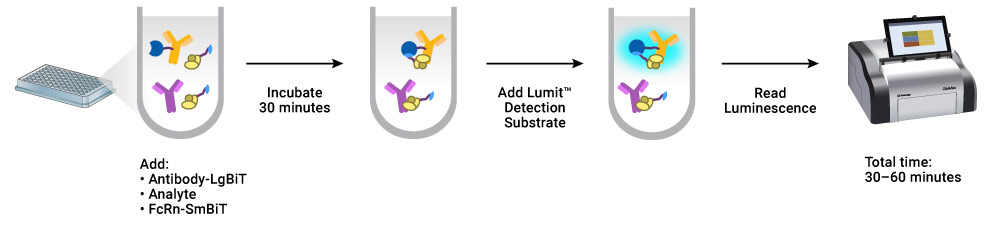

How the Lumit® FcRn Binding Immunoassay Works
In the absence of an antibody analyte, Tracer-LgBiT binds to the hFcRn-SmBiT target, resulting in maximum luminescence signal. In samples containing analyte, nonlabeled IgG will compete with Tracer-LgBiT for binding to the FcRn target, resulting in a concentration-dependent decrease in the luminescent signal.
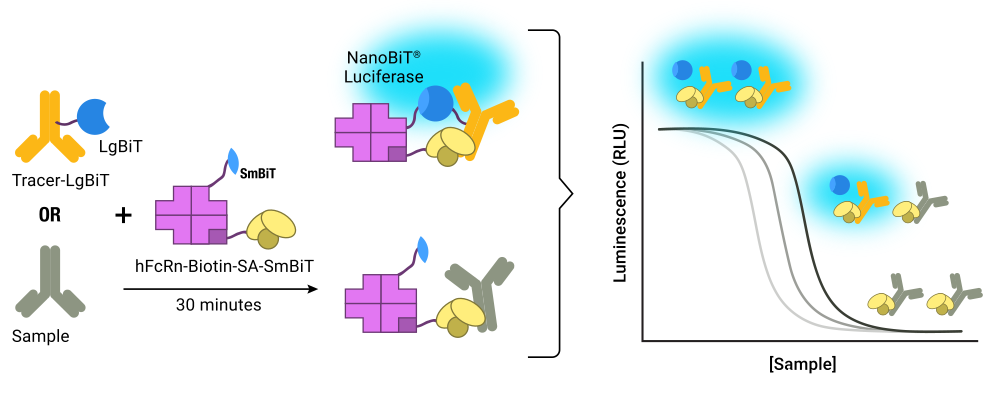
Assay Performance Data
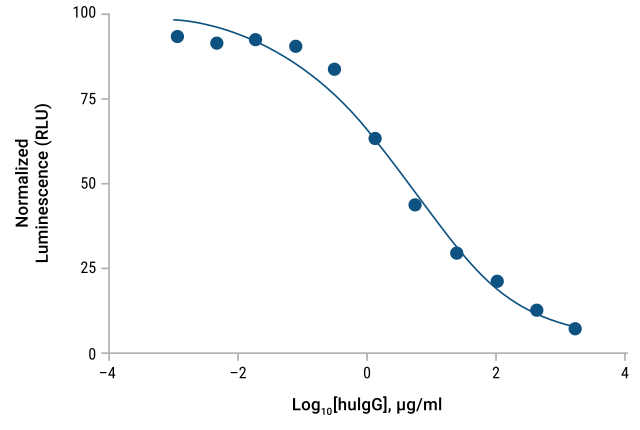
The Lumit® FcRn Binding Immunoassay detects IgG-FcRn interaction. This is a representative standard curve of control antibody plotted as normalized data. Normalized luminescence is calculated by assigning 100% to the maximum bioluminescent signal obtained in absence of an analyte and then calculating percentage drop in signal in the presence of an analyte.
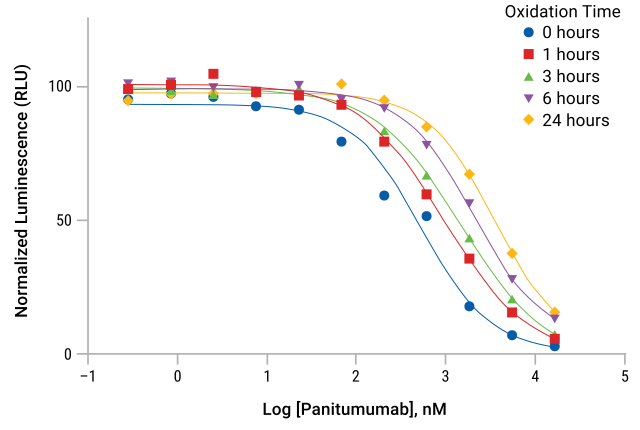
The Lumit® FcRn Binding Immunoassay can detect dose-dependent, oxidation-based loss in antibody-FcRn affinity. Panitumumab was incubated with 0.3% H2O2 for 0–24 hours to induce methionine oxidation.
For one of our projects we had been using an SPR assay to measure FcRn binding but observed some immobilization artefacts. Now, we use Lumit for the same project and get better data in less time.
Dr. Alwin Reiter, Senior Scientist Project Analytics at Formycon AG
Lumit® FcRn Assay Users Share Their Experiences
In this webinar, hear how users implemented the Lumit® FcRn Binding Immunoassay in product development.

Protocols
Complete Protocol
Specifications
Catalog Number:
What's in the box?
| Item | Código | Tamanho |
|---|---|---|
Lumit® Detection Substrate A |
VB301D | 1 × 75μl |
hFcRn-Biotin |
W109A | 1 × 12μl |
Streptavidin-SmBiT |
W110A | 1 × 12μl |
Tracer-LgBiT |
W111A | 1 × 60μl |
FcRn Assay Buffer |
W112A | 1 × 25ml |
pH Adjustment Buffer |
W113A | 1 × 250μl |
Control Antibody |
W114A | 1 × 120μl |
SDS
Search for SDSCertificado de Análise
Restrições de uso
Not For Medical Diagnostic Use.Condições de armazenamento
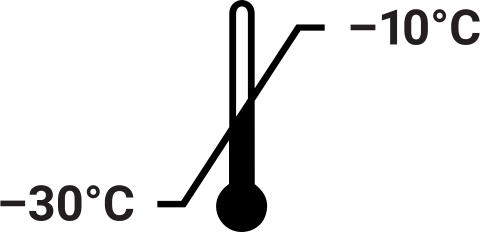
Please see the Protocol for detailed storage conditions.
U.S. Pat. Nos. 9,797,889, 9,797,890, 10,107,800 and 11,493,504; European Pat. No. 2970412; Japanese Pat. Nos. 7280842 and 7532562; and other patents and patents pending.
What's in the box?
| Item | Código | Tamanho |
|---|---|---|
Lumit® Detection Substrate A |
VB301D | 10 × 75μl |
hFcRn-Biotin |
W109A | 10 × 12μl |
Streptavidin-SmBiT |
W110A | 10 × 12μl |
Tracer-LgBiT |
W111A | 10 × 60μl |
FcRn Assay Buffer |
W112A | 10 × 25ml |
pH Adjustment Buffer |
W113A | 10 × 250μl |
Control Antibody |
W114A | 10 × 120μl |
SDS
Search for SDSCertificado de Análise
Restrições de uso
Not For Medical Diagnostic Use.Condições de armazenamento
Please see the Protocol for detailed storage conditions.
U.S. Pat. Nos. 9,797,889, 9,797,890, 10,107,800 and 11,493,504; European Pat. No. 2970412; Japanese Pat. Nos. 7280842 and 7532562; and other patents and patents pending.
Resources
No related resources available
Related Products
Produtos semelhantes
Lumit® Immunoassay Cellular Systems
A no-wash bioluminescent immunoassay to measure levels of target analytes in cell lysates.
W1201, W1202, W1203, W1331, W1332, W1333, W1220
Lumit® FcγR Binding Immunoassays
Novel homogeneous competition assays to measure the interaction between human Fc receptors and antibodies or Fc fusion proteins.
W7030, W7031, W7040, W7041, W7050, W7051, W7060, W7061, W7070, W7071, W7080, W7081
ADCC Reporter Bioassay, V Variant
Measure potency and stability of antibodies mediating ADCC through the high-affinity human FcγRIIIa-V receptor.
G7015, G7014, G7010, G7016, G7013, G7018, G7102, GA1130
FcγRIIa-H ADCP Bioassay
Characterize the Fc effector activity of antibodies that bind and activate the human FcγRIIa-H receptor.
G9901, G9991, G9995, G9871
Frequentemente usado com
GloMax® Discover System
High-performance microplate reader for detecting luminescence, fluorescence and absorbance.
GM3000
ADCC Reporter Bioassay, V Variant
Measure potency and stability of antibodies mediating ADCC through the high-affinity human FcγRIIIa-V receptor.
G7015, G7014, G7010, G7016, G7013, G7018, G7102, GA1130
ADCC Reporter Bioassay, F Variant
Characterize Fc effector activity of antibodies mediating ADCC through the low-affinity human FcγRIIIa-F receptor.
G9790, G9798, G9302