Dual-Luciferase® Reporter Assay System

Sequential Measurement of Firefly and Renilla Luciferase from a Single Sample
- Renilla luciferase serves as a co-transfected internal control, improving data accuracy and reproducibility.
- Sequentially measures firefly and Renilla luciferase activities from a single lysate—no need to split samples into separate wells for normalization.
- Linear over 7 orders of magnitude, with attomole (<10⁻¹⁸ mol) sensitivity when using a sensitive luminometer like a GloMax® Discover.
- Compatible with pGL4 Luciferase Reporter Vectors and DLReady™-validated luminometers.
- Requires a luminometer with two injectors.
Catalog Number:
Size
Catalog Number: E1910
Catalog Number: E1960
Catalog Number: E1980
What Is the Dual-Luciferase® Reporter Assay and How Does It Work?
The Dual-Luciferase® Reporter (DLR™) Assay System is a dual-reporter gene assay that measures the activities of two luciferase enzymes—firefly luciferase (from Photinus pyralis) and Renilla luciferase (from Renilla reniformis, the sea pansy)—sequentially from a single cell lysate. Both reporters are present in the same sample, eliminating the need to split extracts between wells or tubes.
The workflow proceeds in two steps:
- Add Luciferase Assay Reagent II (LAR II) to the lysate. Firefly luciferase oxidizes its D-luciferin substrate in the presence of ATP, Mg²⁺ and O₂, producing a bioluminescent signal that is measured immediately. In this flash assay, signal persists for at least 1 minute, allowing time for measurement. This is the experimental reporter output.
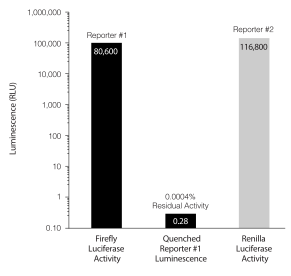
- Add Stop & Glo® Reagent to the same sample. This simultaneously quenches the firefly reaction and initiates the Renilla reaction. Renilla luciferase oxidizes coelenterazine—an ATP-independent reaction—to produce a second luminescent signal. This is the normalization control output.
The ratio of firefly luminescence to Renilla luminescence (the Relative Light Unit ratio, or normalized reporter activity) is calculated for each sample. This ratio corrects for variability in transfection efficiency, cell number and lysis efficiency, yielding highly reproducible data across wells, plates and experiments.
Why Use a Dual-Luciferase System Instead of a Single Reporter?
A single luciferase reporter assay measures absolute luminescence from only the experimental construct. While convenient, single-reporter data are sensitive to well-to-well differences in transfection efficiency, cell viability, and lysis completeness—sources of variability that have nothing to do with the biology being studied.
The DLR™ Assay addresses this limitation directly. By cotransfecting a second luciferase reporter under a weak constitutive promoter (e.g., pRL-TK [Cat.# E6921] expressing Renilla luciferase), every sample carries its own internal standard. Normalizing firefly to Renilla reduces technical noise without requiring the user to split samples, run parallel lysates or add separate protein quantification steps. For more information, see Designing a Bioluminescent Reporter Assay: Normalization Options.
Additional advantages of the dual-reporter format:
- No sample splitting: both reporters are measured from the same lysate tube or well.
- Detects weak promoters: the 7-log linear range and attomole sensitivity when used with a sensitive luminometer make detecting a change in signal possible even when expression is very low.
- No endogenous interference: mammalian cells have no intrinsic luminescence activity, so assay background is negligible.
- Both reactions complete in ~4 seconds per sample with auto-injector luminometers, supporting high-throughput workflows.
What Are the Key Differences Between Firefly and Renilla Luciferase?
Firefly and Renilla luciferases are structurally unrelated enzymes with different substrates, reaction requirements and spectral properties. This orthogonality is what makes dual-reporter assays possible—each enzyme reacts only with its own substrate and can be selectively quenched.
|
Feature |
Firefly Luciferase (Photinus pyralis) |
Renilla Luciferase (Renilla reniformis) |
|---|---|---|
|
Role in DLR™ Assay |
Experimental reporter |
Internal normalization control |
|
Substrate |
D-luciferin |
Coelenterazine |
|
Cofactor requirement |
ATP + Mg²⁺ + O₂ |
O₂ only (ATP-independent) |
|
Typical signal character |
Flash (brighter, short duration) |
Flash (bright, short duration) |
|
Endogenous mammalian activity |
None |
None |
|
Recommended vector family |
pGL4 or pGL3; see Technical Manual #TM259 for vector options |
pRL vectors |
|
Signal in DLR™ Assay |
Measured first (LAR II reagent) |
Measured second (Stop & Glo® reagent) |
Note: Firefly and Renilla assays use entirely separate substrates and buffer systems. Cross-reactivity between the two reactions is negligible in the DLR™ Assay formulation.
Protocols
Complete Protocol
Protocolos rápidos
Frequently Asked Questions
What is a dual-luciferase reporter assay?
A dual-luciferase reporter assay measures the activities of two luciferase enzymes—typically firefly and Renilla—from the same cell lysate. The firefly luciferase reporter reflects experimental gene regulation, while the Renilla luciferase serves as an internal control for normalization. This approach produces more accurate, reproducible results than single-reporter assays by correcting for variation in transfection efficiency, cell number, and lysis.
Why use Renilla luciferase as an internal control?
Renilla luciferase uses a different substrate (coelenterazine) than firefly luciferase (D-luciferin), so the two reactions do not interfere with each other and can be measured sequentially from the same sample. When driven by a weak constitutive promoter, Renilla expression is not expected to change with the experimental variable, making it an ideal reference normalizing for transfection efficiency and cell number across samples.
How do luciferin, ATP and O₂ generate measurable light in a firefly luciferase assay?
Firefly luciferase catalyzes the oxidation of its substrate D-luciferin in a two-step reaction. In the first step, ATP adenylates luciferin to form luciferyl-AMP. In the second step, molecular oxygen oxidizes luciferyl-AMP, producing oxyluciferin in an excited electronic state. When oxyluciferin relaxes to its ground state, it emits a photon of light. This light output is directly proportional to luciferase activity over a wide concentration range.
Does the DLR™ Assay require a special luminometer?
Yes. Because the DLR™ Assay uses a flash chemistry format, a luminometer with two reagent auto-injectors is required to ensure consistent timing between reagent addition and signal measurement. Promega maintains the DLReady™ program, which lists luminometers validated for use with the DLR™ Assay System. For injector-free workflows, consider the Dual-Glo® Luciferase Assay System (Cat.# E2920/E2940/E2980), which uses a stable glow chemistry with a ~2-hour signal half-life. The Dual-Glo® assay is compatible with any plate reader luminometer—no auto-injectors required—and is optimized for batch processing of 96- and 384-well plates.
What is the linear detection range of the DLR™ Assay?
The DLR™ Assay is linear over 7 orders of magnitude (7 logs) for both firefly and Renilla luciferase activities, with attomole (<10⁻¹⁸ mol) sensitivity when using a sensitive luminometer with a wide dynamic range like a GloMax® Discover. This wide dynamic range means that low signal changes can be detected, and highly active samples rarely require dilution before measurement.
When should I use a dual-luciferase assay versus a single-reporter assay?
Use the DLR™ Assay whenever transfection efficiency or cell viability varies across samples, which is typical in most cell-based reporter experiments. Normalization to Renilla eliminates this noise, making your data more reliable.
How can I reduce well-to-well variability in the DLR™ Assay?
The most effective strategies are: (1) normalize firefly to Renilla activity for every sample; (2) ensure consistent cell seeding density and transfection conditions; (3) use a multichannel pipette or liquid handler for lysis and reagent addition; (4) equilibrate all reagents to room temperature; and (5) use a DLReady™ luminometer with auto-injectors to eliminate manual timing variation.
Can the DLR™ Assay be used in cell-free systems?
Yes. The DLR™ Assay System is compatible with cell-free transcription/translation reactions (e.g., TNT® Coupled Reticulocyte Lysate Systems). This enables studying gene expression and regulation in a defined environment without the need for cell transfection—useful for synthetic biology, high-throughput screening and functional assays.
How does NanoLuc® compare to Renilla luciferase for use as an internal control?
NanoLuc® luciferase is up to 1,000-fold brighter than Renilla luciferase when expressed off the same promoter. The Nano-Glo® Dual-Luciferase Reporter Assay System (Cat.# N1610) uses NanoLuc® luciferase as one of the paired reporters. The NanoLuc® reporter is advantageous when reporter expression is very low, or when a brighter control signal is needed to maintain the normalization ratio within a useful dynamic range.
How do I optimize luciferase assay conditions for reproducible results?
Luciferase assay performance is sensitive to several preanalytical and analytical variables. Addressing these systematically is the most reliable path to low-variability, high-quality data.
Cell Density and Transfection
- Seed cells at consistent density 18–24 hours before transfection to ensure uniform confluency (~70–80% at time of transfection).
- Use the same transfection reagent lot and DNA:reagent ratio across all experiments. FuGENE® HD Transfection Reagent is validated for use with DLR™ Assay protocols.
- Always include a Renilla control vector (e.g., pRL-TK, pRL-CMV) at a fixed DNA ratio (typically 1:10 to 1:50 relative to the firefly construct) to enable normalization. Titrate this ratio to keep Renilla signal well within the linear range.
Lysis
- Use Passive Lysis Buffer (PLB) at 1X concentration; avoid freeze-thaw cycles after dilution.
- For adherent cells in 96-well plates, 20μl of 1X PLB per well is the standard volume. Increase volume proportionally for larger wells (e.g., 100μl for 24-well plates).
- Rock the plate at room temperature for 15 minutes to ensure complete lysis. Incomplete lysis is a common source of high variability.
- Freeze lysates at −70°C if not reading immediately; the DLR™ Assay is compatible with frozen lysates.
Measurement Conditions
- Use a DLReady™-validated luminometer with dual auto-injectors. The assay is optimized for 10 to 100μl injection volumes with 2-second delay and 10-second read integration time.
- Allow reagents to equilibrate to room temperature before use. Cold LAR II reagent reduces signal intensity.
- Both LAR II and Stop & Glo® Reagent should be prepared fresh or thawed just before use; avoid repeated freeze-thaw of mixed reagents.
- Read firefly luciferase within 5 minutes of LAR II addition and Renilla luciferase within 30 seconds of Stop & Glo® addition for consistent timing across all wells.
Data Normalization and Linear Range
- Calculate normalized reporter activity as: Firefly RLU ÷ Renilla RLU for each sample. Express results as fold-change relative to a negative control (empty vector or vehicle-treated cells).
- If firefly luciferase signals exceed the linear range of your luminometer (typically ≥10⁶ RLU), dilute lysates 1:10 in 1X PLB and re-measure. The 7-log linear range of the DLR™ Assay means dilution is rarely necessary under standard expression conditions.
- Confirm that Renilla control signals are within the linear range. Overexpression of the Renilla control (caused by excessive pRL vector DNA) can compress the dynamic range of normalization.
- Include a no-DNA transfection control (mock) to establish assay background, and a positive control construct of known activity to verify lot-to-lot consistency.
What can the dual-luciferase reporter assay be used to study?
The DLR™ Assay System is among the most cited reporter gene tools in the life sciences literature. Its combination of sensitivity, linearity and built-in normalization makes it suitable across a broad range of gene regulation research areas:
- Promoter and enhancer activity: Clone a putative regulatory element upstream of the firefly luciferase reporter to quantify its transcriptional activity in response to stimuli, mutations or co-expressed transcription factors.
- Signaling pathway activation: Use pathway-responsive promoter elements (e.g., CRE, NF-κB, AP-1, Wnt/TCF) upstream of firefly luciferase to screen compounds or genetic perturbations that activate or inhibit specific signaling cascades.
- Transcription factor binding and activity: Measure the transactivation potential of transcription factor constructs by co-transfection with reporter vectors containing their cognate binding sites.
- 3′ UTR regulation and miRNA activity: Insert 3′ UTR sequences downstream of the firefly luciferase coding sequence to study post-transcriptional regulation by miRNAs, RNA-binding proteins or other UTR elements.
- siRNA and shRNA validation: Confirm knockdown efficiency of RNA interference constructs by measuring loss of reporter activity driven by the target gene’s promoter or fused to its 3′ UTR.
- Viral promoter and replication studies: Monitor viral gene expression or replication activity using viral LTRs or promoters cloned upstream of firefly luciferase, normalized with a co-transfected Renilla construct.
- Cell-free transcription/translation: The DLR™ Assay is compatible with in vitro transcription/translation reactions, enabling gene expression and regulation studies in a defined environment without the need for cell transfection.
Specifications
Catalog Number:
What's in the box?
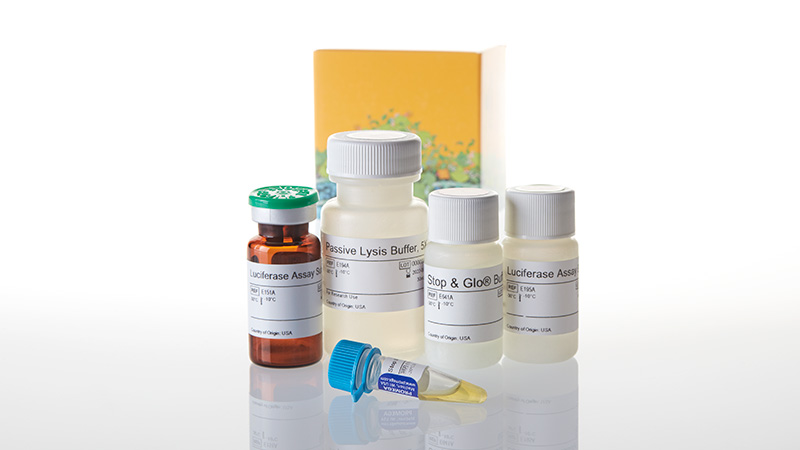
| Item | Código | Tamanho | Available Separately |
|---|---|---|---|
|
Luciferase Assay Substrate |
E151A | 1 × 1 vial | |
|
Passive Lysis Buffer, 5X |
E194A | 1 × 30ml | View Product |
|
Luciferase Assay Buffer II |
E195A | 1 × 10ml | |
|
Stop & Glo® Substrate |
E640A | 1 × 200μl | |
|
Stop & Glo® Buffer |
E641A | 1 × 10ml |
SDS
Search for SDSCertificado de Análise
Restrições de uso
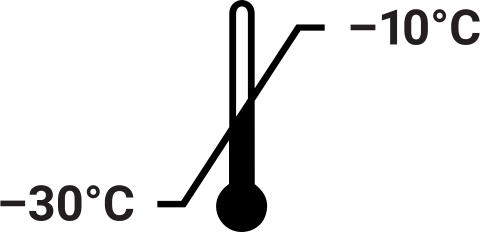
For Research Use Only. Not for Use in Diagnostic Procedures.Condições de armazenamento
What's in the box?
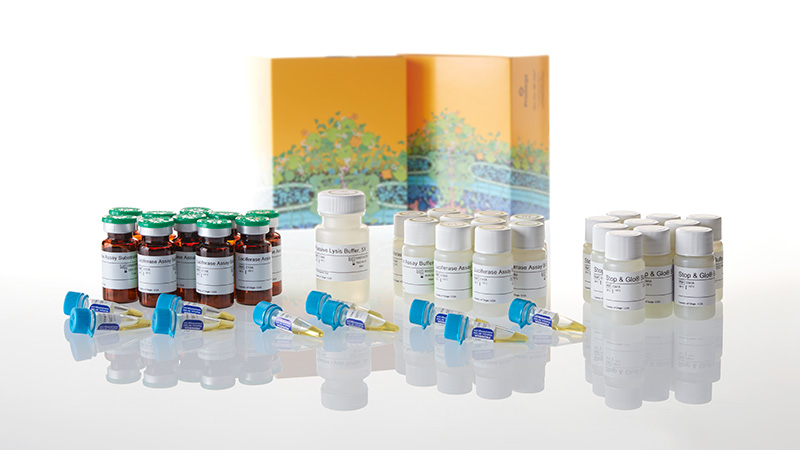
| Item | Código | Tamanho | Available Separately |
|---|---|---|---|
|
Luciferase Assay Substrate |
E151A | 10 × 1 vial | |
|
Passive Lysis Buffer, 5X |
E194A | 1 × 30ml | View Product |
|
Luciferase Assay Buffer II |
E195A | 10 × 10ml | |
|
Stop & Glo® Substrate |
E640A | 10 × 200μl | |
|
Stop & Glo® Buffer |
E641A | 10 × 10ml |
SDS
Search for SDSCertificado de Análise
Restrições de uso
For Research Use Only. Not for Use in Diagnostic Procedures.Condições de armazenamento
What's in the box?
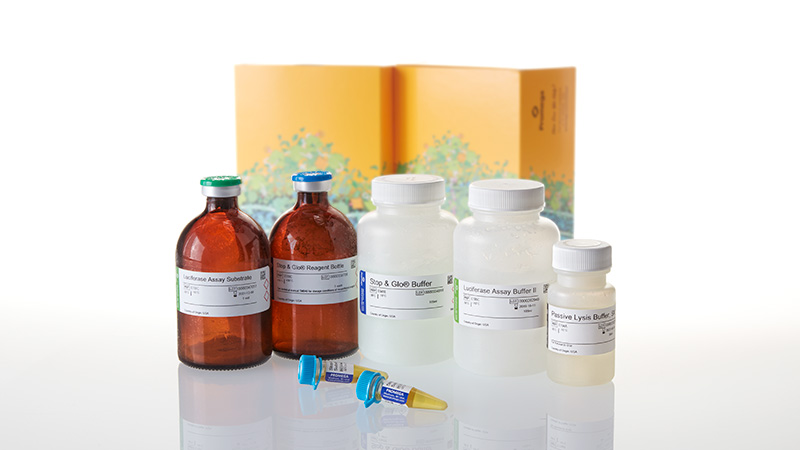
| Item | Código | Tamanho | Available Separately |
|---|---|---|---|
|
Stop & Glo® Reagent Bottle |
E118C | 1 × 1 each | |
|
Luciferase Assay Substrate |
E151C | 1 × 1 vial | |
|
Passive Lysis Buffer, 5X |
E194A | 1 × 30ml | View Product |
|
Luciferase Assay Buffer II |
E195C | 1 × 10⁵ml | |
|
Stop & Glo® Substrate |
E640B | 2 × 1.05ml | |
|
Stop & Glo® Buffer |
E641B | 1 × 10⁵ml |
SDS
Search for SDSCertificado de Análise
Restrições de uso
For Research Use Only. Not for Use in Diagnostic Procedures.Condições de armazenamento
Resources
Artigos
- Targeted zinc-finger repressors to the oncogenic HBZ gene inhibit adult T-cell leukemia (ATL) proliferation
- ACLY as a modulator of liver cell functions and its role in Metabolic Dysfunction-Associated Steatohepatitis
- Gene therapy with AR isoform 2 rescues spinal and bulbar muscular atrophy phenotype by modulating AR transcriptional activity
Related Products
Produtos semelhantes
Nano-Glo® Dual-Luciferase Reporter Assay System
Detecção ultrassensível das atividades da luciferase NanoLuc® e Firefly em uma única amostra.
N1610, N1620, N1630, N1650, N1521, N1531, N1541, N1551
Nano-Glo® Luciferase Assay System
Add-mix-measure assay for NanoLuc® Luciferase with >2 hour half-life in most applications.
N1110, N1120, N1130, N1150
Dual-Glo® Luciferase Assay System
Consecutive detection of firefly and Renilla luciferase activities in a single sample. Two-hour signal half-life. No injectors required.
E2920, E2940, E2980
Bright-Glo™ Luciferase Assay System
A sensitive reporter assay for continuous-processing on robotic systems.
E2610, E2620, E2650
Frequentemente usado com
FuGENE® HD Transfection Reagent
Desempenho otimizado numa ampla faixa de tipos de células, incluindo linhagens celulares de difícil transfecção
E2311, E2312
GloMax® Discover System
High-performance microplate reader for detecting luminescence, fluorescence and absorbance.
GM3000
GloMax® Navigator System
Dedicated microplate luminometer.
GM2000, GM2010
GloMax® 20/20 Luminometer
Ultrasensitive single-tube luminometer.
E5311