pGEM®-T Easy Vector Systems
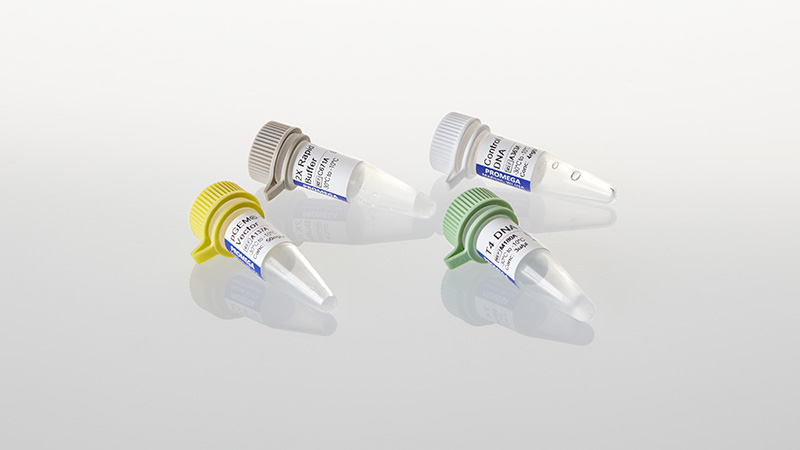
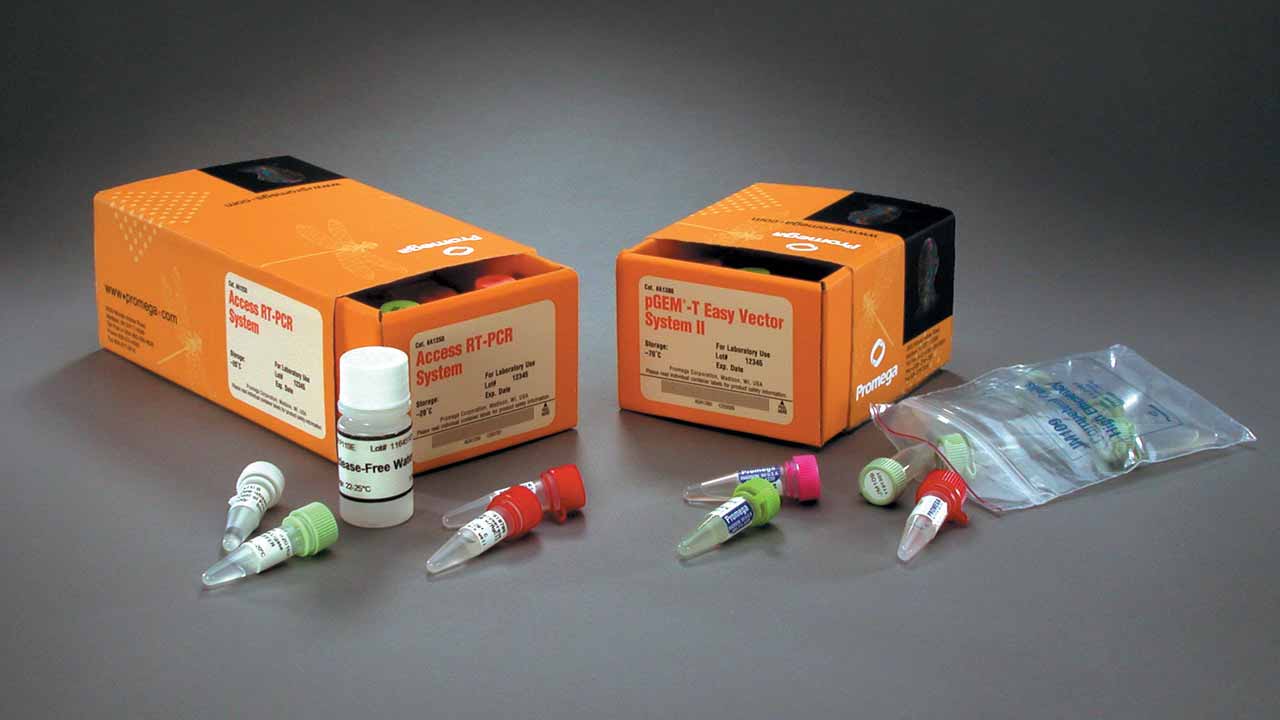
Convenience and Flexibility for Cloning PCR Products
- pGEM®-T Easy Vector allow direct ligation of A-overhang PCR products without blunt-end processing
- Blue/white screening of colonies can be confirmed by colony PCR or sequencing
- Excision of inserts from the pGEM®-T Easy Vector can be performed with a single digest
- Ligation buffer enables ligation in as little as 1 hour at room temperature, with the option to extend incubation for higher colony numbers
- Available with or without competent cells

Catalog Number:
Size
Add competent cells
Catalog Number: A1360
Catalog Number: A1380
Convenience and Flexibility for Cloning PCR Products
The pGEM®-T Easy Vector Systems provide a complete, ready-to-use solution for ligating PCR products directly into a cloning vector—no blunt-end polishing, restriction digestion, or dephosphorylation of the insert required. The pre-linearized vector carries 3′-T overhangs that pair with the single 3′-A overhang that Taq and many other nonproofreading thermostable polymerases add to PCR products, enabling direct, efficient ligation.
- One-hour ligation at room temperature using the included 2X Rapid Ligation Buffer
- Blue/white colony screening identifies recombinant clones directly after transformation
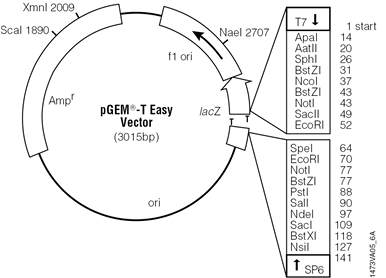
- Three single-enzyme insert excision options: BstZI, EcoRI, or NotI
- T7 and SP6 promoters flank the insert on opposite strands, enabling direct sense or antisense RNA synthesis without subcloning
- f1 origin of replication enables single-stranded DNA production
- Available as System I (vector + ligase) or System II (System I + JM109 Competent Cells)
Important:
- Use only the T4 DNA Ligase supplied with the kit: Other commercial T4 DNA Ligase preparations may contain exonuclease activities that remove the terminal deoxythymidines from the vector T-overhangs, preventing ligation. Only the T4 DNA Ligase provided with pGEM®-T and pGEM®-T Easy Vector Systems has been tested for minimal exonuclease activity.
- UV light exposure: Limit exposure of PCR products to shortwave UV light. Shortwave UV causes formation of pyrimidine dimers in DNA, which will prevent ligation. If gel-visualizing a PCR product, use a glass plate between the gel and UV source, or visualize using a long-wave UV source only. Pyrimidine dimer damage cannot be repaired—if it occurs, the PCR product must be remade.
What Is TA Cloning and How Does It Work?
TA cloning is a method for inserting PCR products into a vector by exploiting the complementary base pairing between the single 3′-A overhang on PCR products (added by Taq polymerase and similar nonproofreading polymerases) and the single 3′-T overhang on the linearized cloning vector. No restriction enzymes or blunt-end processing are required. T4 DNA ligase seals the nicks to produce circular recombinant plasmid.
Standard molecular cloning inserts a DNA fragment into a vector by cutting both with restriction enzymes to produce compatible ends. TA cloning sidesteps this requirement by using a different kind of end compatibility: the nontemplated adenosine that certain thermostable polymerases add to PCR products during extension.
The pGEM®-T Easy Vector is prelinearized at a single restriction site within the multiple cloning region, and a thymidine (T) residue is added to each 3′ end of the linearized vector. These T overhangs pair with the A overhangs on the PCR insert. T4 DNA ligase then joins the compatible ends, producing a covalently closed circular plasmid carrying the PCR-derived insert.
What gives PCR products their 3′-A overhangs?
Taq polymerase lacks a 3′→5′ proofreading exonuclease. In addition to its polymerase activity, Taq exhibits a nontemplated terminal transferase activity: after synthesis of a double-stranded PCR product, it preferentially adds a single deoxyadenosine to the 3′ end of each strand. This A-tailing activity is template-independent and occurs regardless of the sequence at the end of the amplicon.
The efficiency of A-overhang addition depends on the final extension step of the PCR program. A terminal extension of at least 10 minutes at 72°C is recommended to ensure complete A-tailing before ligation.
Which PCR Polymerases Are Compatible with TA Cloning?
Taq polymerase and certain nonproofreading thermostable polymerases add 3′-A overhangs and are directly compatible with TA cloning vectors. Proofreading polymerases such as Pfu, Q5, and Phusion produce blunt-ended products; these require an A-tailing step before TA cloning.
| Polymerase | 3′ End Product | 5′→3′ Exonuclease | 3′→5′ Proofreading |
|---|---|---|---|
| GoTaq/Taq/AmpliTaq | 3′-A overhang | Yes | No |
| Tfl | 3′-A overhang | Yes | No |
| Tth | 3′-A overhang | Yes | No |
| Vent (Tli) | Blunt | No | Yes |
| Deep Vent | Blunt | No | Yes |
| Pfu | Blunt | No | Yes |
| Pwo | Blunt | No | Yes |
How to A-tail PCR products from proofreading polymerases
If your PCR amplification used a proofreading or high-fidelity polymerase, the blunt-ended products must be A-tailed before ligation into pGEM®-T Easy. The A-tailing reaction adds Taq polymerase and dATP to the purified PCR product under conditions that activate terminal transferase activity without substantial de novo synthesis. See Technical Manual #TM042 for a suggested A-tailing protocol.
How Does Blue/White Colony Screening Work in TA Cloning?
Blue/white screening uses disruption of the lacZα gene to distinguish recombinant from nonrecombinant colonies. When an insert is ligated into the multiple cloning site, it disrupts the lacZα coding region, preventing production of functional β-galactosidase. On plates containing X-gal and IPTG, colonies with an insert appear white; colonies without an insert appear blue.
The lacZα complementation mechanism
The pGEM®-T Easy Vector carries the lacZα gene, which encodes the α-peptide fragment of β-galactosidase. The host strain used for transformation (JM109, for example) carries a deletion in the lacZ gene (ΔM15) that removes the α-fragment coding region. Neither the plasmid-encoded α-peptide nor the chromosomally encoded truncated β-galactosidase is active alone, but when both are present in the same cell, they associate to form a functional β-galactosidase enzyme. This is called α-complementation.
When the multiple cloning site within lacZα is disrupted by insertion of a PCR product, the α-peptide is no longer produced in functional form. The cell cannot produce active β-galactosidase regardless of the chromosomal lacZ fragment, and the colony appears white.
Two reagents must be present on the transformation plates for blue/white screening to function:
- X-gal (5-bromo-4-chloro-3-indolyl-β-D-galactopyranoside): a chromogenic substrate for β-galactosidase. When cleaved by functional β-galactosidase, it produces an insoluble blue indigo dye. Colonies where α-complementation is intact turn blue. Colonies where lacZα is disrupted by an insert remain white.
- IPTG (isopropyl-β-D-thiogalactopyranoside): a nonhydrolysable inducer of the lac operon. IPTG is required to induce expression of the lacZα gene on the plasmid. Without IPTG, lacZα expression is too low for reliable blue color development.
For details on blue/white colony screening with TA cloning, see Technical Manual #TM042.
How do I excise the insert from the pGEM®-T Easy Vector, and what downstream applications are supported?
Inserts can be released from pGEM®-T Easy by single-enzyme digestion with BstZI, EcoRI, or NotI. Recognition sites for all three enzymes flank the insertion site. The vector’s T7 and SP6 promoters support in vitro transcription of the cloned insert, and the f1 origin enables single-stranded DNA production for applications such as site-directed mutagenesis. View our current list of restriction enzymes.
For more information on applications for PCR products cloned into the pGEM®-T Easy Vector, see the Molecular Cloning Guide.
Protocols
Complete Protocol
Protocolos rápidos
Frequently Asked Questions
Can blue colonies still contain an insert?
Yes, occasionally. If the insert is very small (typically under ~100bp) or happens to be in-frame with the lacZα reading frame, the α-peptide may remain functional despite the insertion, and the colony will appear blue. This is uncommon but possible, particularly with short PCR amplicons. For this reason, blue/white selection is a screening aid, not a definitive result—if blue colony numbers seem unexpectedly high, pick a sample of blue colonies alongside white ones and confirm all by colony PCR.
Do all white colonies contain the correct insert?
No. White colonies indicate disruption of lacZα but do not confirm the identity of the insert. Common false positives include: primer dimer ligation products, nonspecific PCR amplification products, and vector self-ligation events that incidentally disrupt lacZα. Always confirm white colonies by colony PCR using primers flanking the insertion site (pUC/M13 fwd/rev; Q5601/Q5401), followed by sequencing to verify sequence identity and orientation.
What is the correct insert:vector molar ratio for pGEM®-T Easy ligation?
The pGEM®-T Easy Vector Systems were optimized using a 1:1 molar ratio of Control Insert DNA to vector, but ratios of 8:1 to 1:8 have been used successfully. Ratios of 3:1 to 1:3 are good initial parameters when working with a new PCR product. To calculate the amount of insert needed:
ng of insert = (ng of vector × kb size of insert ÷ kb size of vector) × insert:vector molar ratio
Example: How much of a 0.5kb PCR product is needed for 50ng of pGEM®-T Easy Vector (3,015bp) at a 3:1 insert:vector ratio?
(50ng × 0.5kb ÷ 3.015kb) × 3 = approximately 25ng of insert
At a 1:1 ratio, the same insert requires approximately 8.3ng. The BioMath Calculator can perform this calculation automatically.
When should blunt-end cloning be used instead of TA cloning?
Blunt-end cloning is preferable when:
- The insert sequence already has compatible restriction enzyme sites introduced by PCR primers, enabling directional cloning;
- The insert will be cloned into an expression vector requiring a specific reading frame; or
- High-fidelity sequence accuracy at the insertion junction is required and A-tailing introduces unwanted sequence context.
TA cloning is faster and requires fewer enzymatic steps, but does not control insert orientation. If directional insertion is required, design primers with flanking restriction sites and subclone after sequence verification.
Why does the 2X Rapid Ligation Buffer enable fast ligation?
Conventional T4 DNA ligation buffers typically require 4°C overnight incubation for efficient single-base-overhang ligation. The 2X Rapid Ligation Buffer supplied with pGEM®-T Easy achieves room-temperature ligation in 1 hour through its optimized composition that includes PEG (from Technical Manual #TM042). PEG acts as a molecular crowding agent that increases the effective local concentration of DNA ends, dramatically accelerating ligation kinetics even at room temperature.
Two critical handling notes from Technical Manual #TM042:
- The ATP in the buffer degrades during temperature fluctuations—make single-use aliquots and avoid repeated freeze-thaw cycles. Use a fresh vial if ligation efficiency is poor.
- Do not dilute the 2X buffer; PEG concentration is essential. Vortex the buffer vigorously before each use, as PEG can cause the buffer to appear viscous or phase-separated.
What is the difference between pGEM®-T Easy System I and System II?
System I (Cat.# A1360) contains the pGEM®-T Easy Vector, Control Insert DNA, 2X Rapid Ligation Buffer, and T4 DNA Ligase—everything needed for ligation. System II (Cat.# A1380) includes all System I components plus six tubes of JM109 High Efficiency Competent Cells, providing an all-in-one solution if the user’s lab does not maintain a competent cell supply. JM109 cells are the recommended host strain for blue/white selection because they carry the lacZΔM15 deletion required for α-complementation.
Why must I use the T4 DNA Ligase supplied with the pGEM®-T Easy system?
The T4 DNA Ligase provided with pGEM®-T and pGEM®-T Easy Vector Systems has been specifically tested and selected for minimal exonuclease activity. Other commercial T4 DNA Ligase preparations may contain contaminating exonucleases that remove the single 3′-terminal thymidine residues from the vector’s T-overhangs, converting the T-vector to a blunt-ended molecule. If this happens, the vector can re-circularize without insert and the ligation reaction will produce predominantly blue colonies. Always use the T4 DNA Ligase included in the kit, not a substitute from another system.
Can I TA-clone a PCR product made with a high-fidelity polymerase like Q5 or Phusion?
Not directly, but it works after one added step. High-fidelity proofreading polymerases (including Pfu, Q5, and Phusion) have 3′→5′ exonuclease activity and produce blunt-ended PCR products, which lack the single 3′-A overhang that TA cloning requires. To clone these products into the pGEM®-T Easy Vector, add an A-tailing step first: incubate the purified blunt product with Taq DNA Polymerase and dATP (70°C, 15–30 min) to add 3′-A overhangs, then ligate as usual. Purify the PCR product before A-tailing, to prevent residual proofreading polymerase from removing the added A or stripping the vector’s T-overhang.
Specifications
Catalog Number:
What's in the box?
| Item | Código | Tamanho | Concentration | Available Separately |
|---|---|---|---|---|
|
pGEM®-T Easy Vector |
A137A | 1 × 1.2μg | 50ng/μl | |
|
Control Insert DNA |
A363A | 1 × 12μl | ||
|
2X Rapid Ligation Buffer |
C671A | 1 × 200μl | View Product | |
|
T4 DNA Ligase |
M180A | 1 × 100u |
SDS
Search for SDSCertificado de Análise
Restrições de uso
For Research Use Only. Not for Use in Diagnostic Procedures.Condições de armazenamento

See Protocol for detailed storage recommendations.
What's in the box?
| Item | Código | Tamanho | Concentration | Available Separately |
|---|---|---|---|---|
|
pGEM®-T Easy Vector |
A137A | 1 × 1.2μg | 50ng/μl | |
|
Control Insert DNA |
A363A | 1 × 12μl | ||
|
T4 DNA Ligase |
M180A | 1 × 100u | ||
|
2X Rapid Ligation Buffer |
C671A | 1 × 200μl | View Product | |
|
JM109 Competent Cells, High Efficiency |
L200A | 6 × 200μl |
SDS
Search for SDSCertificado de Análise
Restrições de uso
For Research Use Only. Not for Use in Diagnostic Procedures.Condições de armazenamento
See Protocol for detailed storage recommendations.
Related Products
Produtos semelhantes
Frequentemente usado com
GoTaq® G2 Master Mixes
Second-generation, high-performance GoTaq® G2 DNA Polymerase in a ready-to-use master mix.
M7822, M7823, M7832, M7833
GoTaq® G2 DNA Polymerase
Latest generation GoTaq® polymerase—high-performance for your everyday PCR needs.
M7841, M7845, M7848
GoTaq® G2 Flexi DNA Polymerase
Second-generation, high-performance GoTaq® G2 DNA Polymerase with Mg-free buffers.
M7801, M7805, M7806, M7808
GoTaq® G2 Hot Start Polymerase
High-performance hot-start GoTaq® G2 enzyme with convenient room-temperature setup.
M7401, M7405, M7406, M7408