Choosing a Luciferase Reporter Assay

A reporter assay comparison guide.

View All Luciferase Reporter Assays

Luciferase Reporters and Detection Reagents

When creating a luciferase reporter assay, there are two important elements to consider: the luciferase reporter protein itself and the assay chemistry used to detect reporter activity. The characteristics of these two components together contribute to the overall performance of the assay. By selecting the reporter/detection solution that is optimal for your experimental goals, you can customize your luciferase reporter assay to create the best solution for your research.

Promega offers a choice of 3 different luciferase reporters: NanoLuc® Luciferase (Nluc,19kDa), Renilla Luciferase (Rluc, 36kDa) and Firefly Luciferase (Fluc, 61kDa), which vary in size, brightness and protein half-life.

Luciferase Comparison Table
Luciferase Reporter
Size
Brightness
Approx. Protein Half-life
Compatible with Extracellular Environment
Orthogonality
Firefly Luciferase
61kDa
+
3 hours*
No, ATP-dependent
NanoLuc and Renilla
NanoLuc® Luciferase
19kDa
+++
>6 hours*
Yes, ATP-independent**
Firefly
Renilla Luciferase
36kDa
+
3 hours
Yes, ATP-independent
Firefly

*Destabilized versions available to more tightly couple to transcriptional response.
**Secreted versions available.

Browse Reporter Vectors and Cell Lines

Detection Reagent Considerations

Multiple assay detection reagents are also available for each reporter. Key considerations for selecting the optimal assay reagent include:

  • Signal intensity and overall dynamic range needed for the assay.
  • Signal stability, or half-life, which will impact your processing workflow.
  • Processing steps required. Non-homogenous assays require a separate lysate creation step prior to reagent addition. Homogenous assay reagents are added directly to the cells in culture eliminating sample pre-processing.
  • Lytic or live-cell reporter detection
  • Single or dual-reporter detection

Luciferase Signal Strength and Stability
Dual-Luciferase® Assay Options

Firefly Luciferase Assay Options

RECOVER_RECOVER_12881mb-animation_HTML5 Canvas

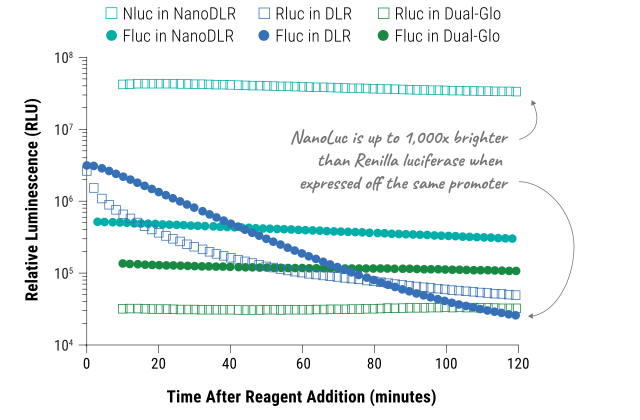
Here, we compared luminescence signals from HEK293 cells transfected with a 1:1:8 ratio of either TK-Rluc (Renilla):TK-Fluc (firefly):carrier DNA or TK-Nluc (NanoLuc):TK-Fluc:carrier DNA and assayed with NanoDLR™, DLR™ or Dual-Glo® Luciferase Assay Systems as indicated. The NanoDLR(TM) and Dual-Glo(R) reagents are homogenous assay systems with increased signal stability. The DLR(TM) reagent is a non-homogenous assay with a flash signal that decays rapidly.

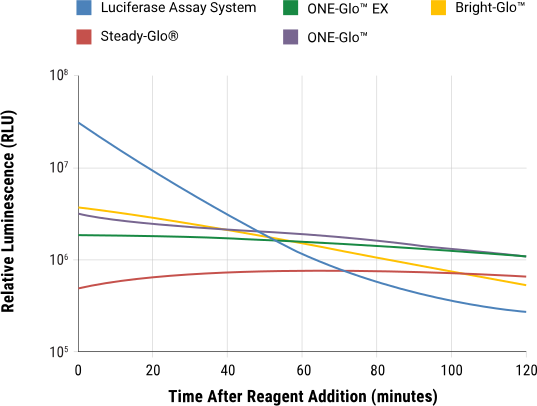
Here we demonstrate luminescence signal over time from a dilution of QuantiLum® Recombinant Luciferase assayed with various firefly luciferase detection reagents as indicated. The Luciferase Assay System is a non-homogenous reagent that provides the brightest initial luminescence with flash kinetics that has rapid signal decay. The Bright-Glo™, ONE-Glo™, ONE-Glo™ EX, and Steady-Glo® systems are homogenous reagents that show progressively decreasing levels of initial brightness with respective increases in signal half-life.

Dual-Luciferase® Assay Options

12881MB-W

Here, we compared luminescence signals from HEK293 cells transfected with a 1:1:8 ratio of either TK-Rluc (Renilla):TK-Fluc (firefly):carrier DNA or TK-Nluc (NanoLuc):TK-Fluc:carrier DNA and assayed with NanoDLR™, DLR™ or Dual-Glo® Luciferase Assay Systems as indicated. The NanoDLR(TM) and Dual-Glo(R) reagents are homogenous assay systems with increased signal stability. The DLR(TM) reagent is a non-homogenous assay with a flash signal that decays rapidly.

Firefly Luciferase Assay Options

12881mb-w3

Here we demonstrate luminescence signal over time from a dilution of QuantiLum® Recombinant Luciferase assayed with various firefly luciferase detection reagents as indicated. The Luciferase Assay System is a non-homogenous reagent that provides the brightest initial luminescence with flash kinetics that has rapid signal decay. The Bright-Glo™, ONE-Glo™, ONE-Glo™ EX, and Steady-Glo® systems are homogenous reagents that show progressively decreasing levels of initial brightness with respective increases in signal half-life.


Compare Luciferase Assay Characteristics

Bioluminescent Reporter Assay Design

Interested in learning more about reporter assay design? Our two-part "Designing a Bioluminescent Reporter Assay" guide will walk you through basic considerations for choosing the optimal experimental reporter, experimental design and data analysis methods.